How to Hear From Far Away With Your iPhone (2026 Guide)
The same iPhone hardware that struggles through a concrete wall performs surprisingly well over open distance. With the right app, a decent set of headphones, and some technique, you can extend usable listening range to about 20–30 metres — enough for most real-world “I want to hear that from where I am” scenarios.
This guide covers the technique, the honest range limits, and the three use cases where iPhones do it well. To check the noise floor at your target location (which caps range harder than gain does), use our browser decibel meter to measure the ambient dB before you set up.
What long-distance listening on iPhone actually is
Long-distance amplification is not the same problem as wall listening. Through a wall, the barrier attenuates sound by 30–60 dB; you’re fighting a massive signal-loss ceiling. Over open air, sound follows the inverse-square law — it halves in pressure with each doubling of distance — but there’s no barrier. The signal is quieter but not blocked.
That difference matters. iPhone microphones are actually quite sensitive; what limits you outdoors is usually your side’s ambient noise (wind, traffic, your own breathing), not the target being too quiet.
Range limits by environment
| Environment | Usable range | Notes |
|---|---|---|
| Quiet indoor room, still air | 30–40 m | Ambient noise floor is the ceiling |
| Large indoor space (theatre, atrium) | 20–30 m | Reverb makes intelligibility harder before it makes it quieter |
| Outdoor, calm and rural | 20–30 m | Wind is the enemy — anything over 10 km/h destroys it |
| Outdoor, urban | 5–15 m | Traffic noise sets the floor |
| Outdoor, windy | 3–10 m | Wind directly on the mic overwhelms everything |
“Usable” means you can follow speech content, not just hear that someone is talking. Voices remain detectable at much longer distances than they remain intelligible.
The three iPhone long-distance use cases that work
1. Birding and wildlife listening
Ornithologists have used iPhone recorders in the field for a decade. The workflow: iPhone + directional external microphone (or built-in mic for close subjects) + amplifier app + wired earbuds. Third-party recording apps like Merlin (Cornell Lab of Ornithology) even do live species identification from the audio.
For pure listening without identification, an amplifier app with a boosted 1–4 kHz band captures bird vocalizations while suppressing low-frequency wind rumble. Range with the built-in iPhone mic is roughly 10 metres for songbirds; add a $50 external shotgun mic (Rode VideoMicro or similar) and that jumps to 30+ metres.
2. Concerts, lectures, live events
Long-range listening at concerts is more about clarity than raw distance. You can hear the stage from the back row — you just can’t understand it clearly over the crowd noise. An amplifier app with speech-band EQ (300 Hz–3 kHz boost, everything else cut) can significantly improve intelligibility of a spoken introduction or lyrics.
For instrumental music the same technique fails — instruments span the full frequency range and don’t cleanly separate from crowd hum.
Try Spy Hearing3. Hearing across a large room
The most common everyday use: you’re at one end of a big open-plan space, want to hear something happening at the other end. Amplifier app + AirPods, phone pointed at the target, EQ tuned for speech, gain around 70%. Usable to about 25 metres in a quiet room.
This is also the use case where Live Listen holds up reasonably well within its ~15 m Bluetooth range — see Live Listen alternatives and limits for the full comparison.
The technique that actually extends range
The difference between a good long-distance listening session and a frustrating one usually isn’t the app — it’s positioning and setup.
- Point the bottom of the iPhone at the target. The primary mic (and beamforming array) is at the bottom edge. Aim it like a shotgun mic.
- Elevate the iPhone. Waist-height on a fence, table, or tripod is dramatically better than at your side. Reduces ground-reflected noise.
- Deaden your own side. Turn away from your car, walk away from HVAC units, silence the phone.
- Fight wind if outdoors. A cheap foam windscreen ($5) that fits over the iPhone’s bottom mic makes a real difference in any breeze. Even a thin sock works in emergencies.
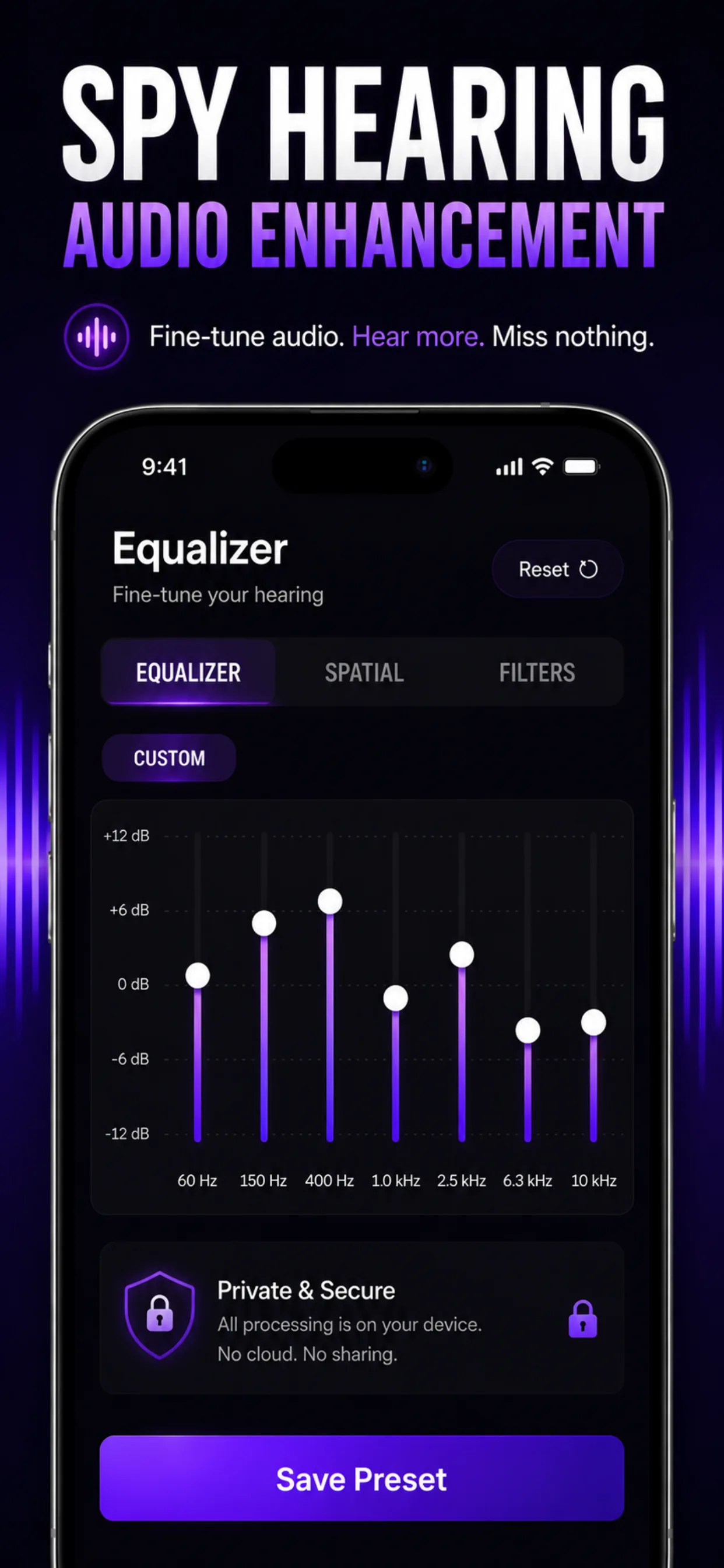
- Use the EQ for speech. Cut everything below 200 Hz (kills low rumble, distant traffic), boost 500 Hz–3 kHz (speech intelligibility band), cut above 5 kHz (mic hiss).
- Wired headphones win outdoors. Bluetooth interference from other devices in a crowd is unpredictable; a wired connection is reliable.
When you need an actual parabolic microphone
Amplifier apps hit a ceiling around 30 metres outdoors under ideal conditions. Beyond that, the target signal is quieter than the iPhone microphone’s noise floor and no amount of digital gain will recover it.
The physical solution is a parabolic or shotgun microphone — a directional mic that gathers sound from a narrow forward cone and rejects everything else. Costs range from about $50 (Rode VideoMicro, decent shotgun) to $2,000+ (Klover MiK sports mic, broadcast-grade parabolic).
Parabolics don’t add gain — they add selectivity. The math works out to roughly 15–20 dB of effective boost for on-axis sound versus omnidirectional capture, which is like doubling your usable distance. Cheap shotguns give you maybe 6–10 dB.
Combined with an iPhone amplifier app, a $50 shotgun mic extends practical range to about 50 metres outdoors — enough for most non-professional needs.
What “long-distance listening” apps cannot do
- Hear a specific conversation in a crowd. Beamforming helps but is limited; iPhone mics aren’t shotgun mics.
- Reject wind. Software noise cancellation cannot recover a signal buried under wind rumble on the mic capsule.
- Extend range across a body of water. Water surfaces reflect sound weirdly and the humidity attenuates high frequencies. Nature’s own high-pass filter.
- Hear through moving traffic. Traffic noise floor is around 60–70 dB; anything quieter than that at your position is lost.
Legal note
Amplified listening in a public space is generally legal — a park, a public street, a concert venue you paid to attend. Listening across a fence into a private conversation, even with just amplification and no recording, gets legally murky and depends on state law. Recording that amplified audio is separately governed by the same state-consent rules that apply to any recording.
Full breakdown at Recording laws by state. This article is educational, not legal advice.
Related reading
- Best iPhone sound amplifier apps — tested — which apps actually amplify well
- Live Listen alternatives + limits — the free built-in option’s ~15 m range ceiling
- Listen through walls with your iPhone — how-to — different problem, different technique
- Recording laws by state — before you record anything long-distance
Frequently asked questions
- How far can an iPhone hear with an amplifier app?
- Usable range under calm outdoor conditions is roughly 20–30 metres for intelligible speech. Indoor in a quiet room, that stretches to 30–40 metres. Any wind, traffic, or ambient noise on your side reduces the number sharply. Beyond about 30 metres outdoors, you need a directional shotgun or parabolic microphone — iPhone software alone cannot extend further because the target signal drops below the mic's own noise floor.
- Can I hear a conversation across a room with my iPhone?
- Yes, in a reasonably quiet room. Point the iPhone's bottom edge (primary microphone) at the conversation, use headphones, apply speech-band EQ (300 Hz–3 kHz boost, low frequencies cut), and set gain to about 70%. Third-party amplifier apps (see our best sound amplifier apps roundup) offer 3–4× more gain than Apple's built-in Live Listen for this use case.
- What's the best iPhone app for long-distance listening?
- For general long-range amplification, third-party apps with high gain and EQ presets (Spy Hearing, Sound Amplifier: Hearing Aid, Petralex) outperform Apple's built-in Live Listen — both in gain ceiling and in speech intelligibility. For birding specifically, Merlin adds species identification. For maximum range regardless of app, pair with an external shotgun or parabolic microphone.
- Does an external microphone help for long distance?
- Yes, significantly. A basic $50 shotgun mic (Rode VideoMicro, Sennheiser MKE 200) adds roughly 6–10 dB of directional selectivity — the effect is like doubling usable range for on-axis sound. A full parabolic mic ($500+) adds 15–20 dB. Both plug into the iPhone via a Lightning-to-3.5mm adapter or USB-C interface. Directional mics also reject noise from other directions, which is often more useful than pure amplification.
- How does wind affect long-distance listening on iPhone?
- Severely. Wind hitting the microphone capsule creates low-frequency rumble that overwhelms any signal above about 10 km/h. A cheap foam windscreen ($5) that fits over the iPhone's bottom microphone substantially reduces this. Software noise reduction cannot fix wind that's already saturated the microphone input — the damage is done at capture time.
- Is it legal to listen to conversations from far away with an iPhone?
- In public spaces (parks, streets, ticketed events), amplified listening is generally legal. Listening across property lines into a private conversation — even amplified, even without recording — falls into a legally murky area that varies by state. Recording is governed by separate state consent rules (one-party in 38 states, all-party in 12). Federal law prohibits recording conversations you're not a party to regardless of state.